Symfony 8.2 Is Coming: What Drupal Developers Should Actually Track
· 8 min read

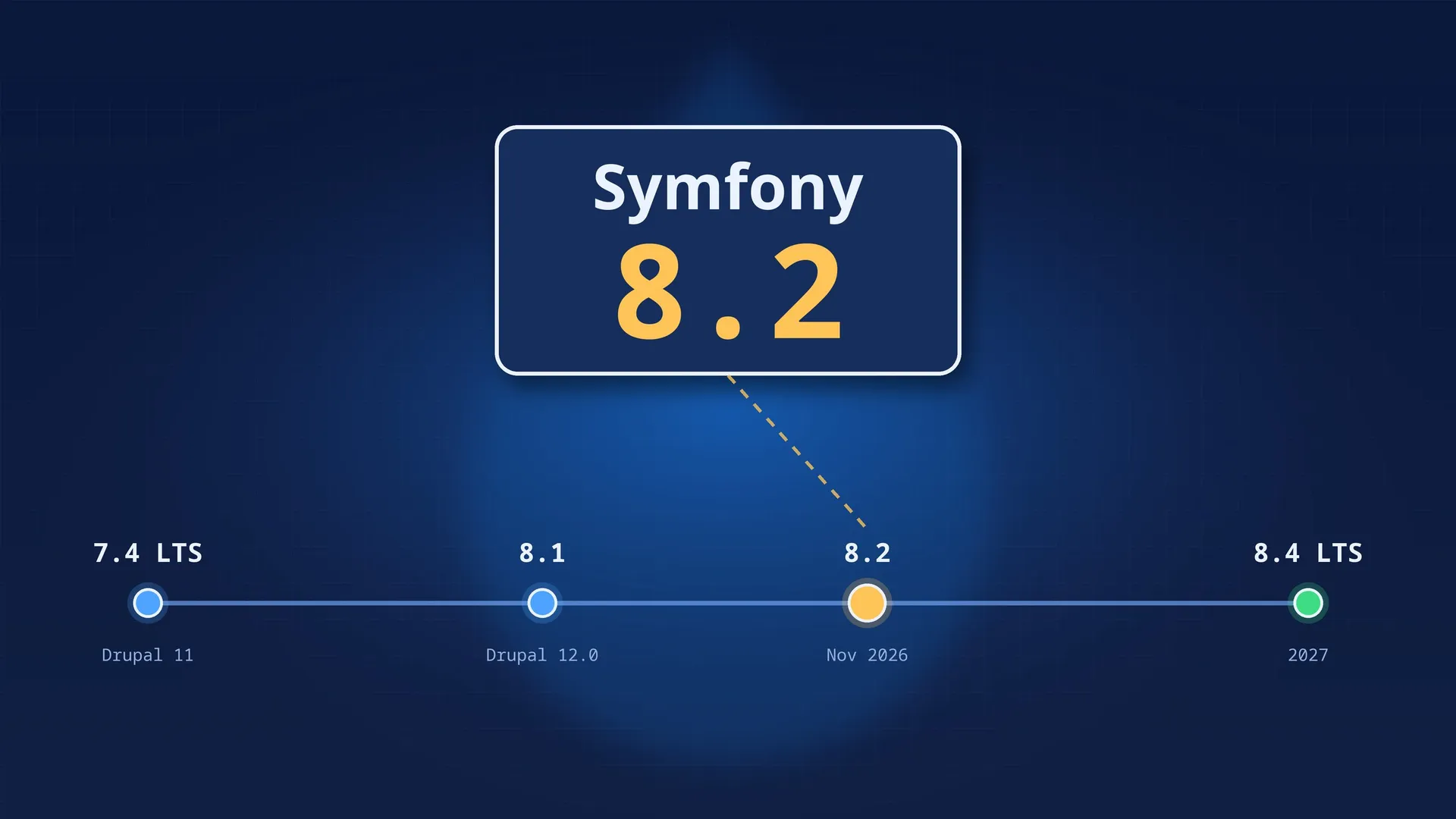
Symfony 8.2 is expected at the end of November 2026. Drupal 12.0.0 is scheduled for the week of 7 December. The two dates are close, and the Symfony blog is currently publishing a “New in Symfony 8.2” post almost every day.
The catch is that most of those features are about the full-stack Symfony framework (FrameworkBundle, Messenger, Forms, Security, AssetMapper…). Drupal doesn’t use the framework: it uses about fifteen components. Reading the whole series while asking “what does this change for my Drupal site?” wastes a lot of time.
This article sorts it out: the timeline, what actually touches Drupal code, what you can ignore, and what to do now.
The information comes from the Symfony 8.2 upgrade notes (UPGRADE-8.2.md, beta at the time of writing) and from the 11.5.x and 12.0.x branches of Drupal core. Symfony 8.2 isn’t out yet, so some details may still change.
| Version | Released | End of support | Used by |
|---|---|---|---|
| Symfony 7.4 LTS | November 2025 | bugs: November 2028, security: November 2029 | Drupal 11.3, 11.4, 11.5 |
| Symfony 8.1 | May 2026 | January 2027 | Drupal 12.0 (beta) |
| Symfony 8.2 | November 2026 | July 2027 | not Drupal yet |
Two takeaways:
This isn’t a guess; it’s what the history of core/composer.json shows:
| Drupal | Symfony required | Pinned by drupal/core-recommended |
|---|---|---|
| 11.0.0 | ^7.1 |
~v7.1.3 |
| 11.1.0 | ^7.2 |
~v7.2.0 |
| 11.2.0 | ^7.3 |
~v7.3.0 |
| 11.3.0 | ^7.4 |
~v7.4.0 |
| 12.0.0-beta1 | ^8.1 |
~v8.1.6 |
Each Drupal 11 minor release adopted the next Symfony minor, up to the 7.4 LTS. Drupal 12 will follow the same path: 8.1, then 8.2, and so on up to the next LTS. Following Symfony’s usual cycle (one release in May, one in November), that will be 8.4, expected at the end of 2027.
What remains open is whether Drupal 12.0.0 ships directly on 8.2 or switches right after. At the time of writing, the 12.0.x branch still pins 8.1. The Drupal core issue queue is the place to watch.
drupal/core vs drupal/core-recommended: the difference matters hereThe right-hand column of that table matters. Check what your project requires:
composer show drupal/core-recommended 2>/dev/null && echo "core-recommended" || echo "drupal/core only"
composer why symfony/http-kerneldrupal/core-recommended (what drupal/recommended-project uses), Symfony is pinned to a patch range (~v8.1.6). You’ll move to 8.2 when Drupal core has decided and tested it. That’s the behaviour you want in production.drupal/core only, the constraint is ^8.1. A composer update the day after Symfony 8.2 ships will install 8.2 before Drupal core has validated it. On Drupal 11 this can’t happen: ^7.4 can’t go beyond 7.4, the last release of the 7 branch. On Drupal 12, it’s a real minor version jump.If a Drupal 12 project of yours depends on drupal/core only, keep this in mind during the December and January updates.
These are the components required by core/composer.json on the 12.0.x branch:
console, dependency-injection, event-dispatcher, filesystem, finder, http-foundation, http-kernel, mailer, mime, process, psr-http-message-bridge, routing, runtime, serializer, validator, yaml (plus a polyfill).
No FrameworkBundle, no Messenger, no Form, no Security, no Translation, no ExpressionLanguage. And even for the components it does use, Drupal often replaces the central piece with its own:
ContainerBuilder, then exported by Drupal’s dumper (OptimizedPhpArrayDumper), not Symfony’s;NormalizerBase, JSON:API) are Drupal’s own and don’t extend AbstractObjectNormalizer;UrlGenerator and router.That’s what makes it possible to sort the 8.2 changes quickly.
With Symfony Console 8.2, a command stopped by a signal no longer exits with 0, but with 128 + the signal number: 130 for SIGINT (Ctrl+C), 143 for SIGTERM.
Drush is built on Symfony Console. In practice, on a Drupal 12 project once it moves to Console 8.2:
drush queue:run, or any other worker started by systemd, supervisord or Kubernetes and stopped cleanly with SIGTERM, will exit with 143;systemctl stop, unless the command handles SIGTERM itself;The systemd fix is simple:
[Service]
ExecStart=/var/www/vendor/bin/drush queue:run my_queue --time-limit=3600
SuccessExitStatus=143
Another, rarer Console 8.2 change: if both app:import and app:import:users exist, app:import users now runs app:import:users instead of passing users as an argument to app:import. If you have custom Drush commands nested that way, test them.
Symfony 8.2 deprecates a very common pattern:
// Before: the object read from the session is changed, set() is never called.
$session = $request->getSession();
$session->get('my_module.cart')->addItem($item);
In Symfony 9.0, objects read from the session will be copies: only what’s passed to set() will be saved. The code above will silently lose its changes.
The form to adopt now:
$session = $request->getSession();
$cart = $session->get('my_module.cart');
$cart->addItem($item);
$session->set('my_module.cart', $cart);
One point that matters for Drupal: Drupal’s session.attribute_bag service is Symfony’s AttributeBag, created without the $debug argument. This deprecation won’t show up in your Drupal logs. You have to look for these patterns yourself, in custom and contrib modules:
grep -rnE "getSession\(\)->get\([^)]*\)->" web/modules/customIt isn’t urgent for Drupal 12, but it’s exactly the kind of code that breaks quietly the day Drupal moves to Symfony 9.
Several Serializer 8.2 changes are about ObjectNormalizer and denormalizing into typed PHP classes:
list<...>-typed property is deprecated (an exception in 9.0);list<CardPayment|BankTransfer>) are now actually denormalized, and an element that matches no member of the union throws instead of being returned as-is;#[SerializedName] now applies to properties like $isActive with an isActive() accessor.Drupal’s entity normalizers (REST, JSON:API) aren’t affected. But if you have an integration module that does $serializer->deserialize($json, PartnerDto::class, 'json') to consume an external API, review your DTOs and run your tests. The announced Serializer performance gains (14 to 24% on list normalization) are on that ObjectNormalizer path too, not on Drupal’s entity normalizers: don’t expect a faster JSON:API.
Path::isBasePath() is deprecated; pass "/".AsDecorator::$priority and AsEventListener::$priority become ?int (default null). This only matters for code that reads those attributes through reflection.Symfony\Component\EventDispatcher\EventDispatcherInterface autowiring alias is deprecated in favour of Symfony\Contracts\EventDispatcher\EventDispatcherInterface. Drupal declares its own aliases in core.services.yml, so you won’t get the deprecation. Still, for a service that only dispatches, type-hinting the Contracts interface is the right choice.These features are headlining the Symfony blog, but they don’t touch a Drupal site:
CompiledEventDispatcher: it’s the framework’s event_dispatcher service that changes. Drupal’s stays Symfony\Component\EventDispatcher\EventDispatcher on the 12.0.x branch, fed by the classic RegisterListenersPass. Your subscribers don’t change (see Event API).XmlDumper): Drupal uses its own dumper.router.strict_requirements: that’s a framework option.One new feature is worth following even if it doesn’t concern you yet: symfony/json-schema. It generates JSON Schema or OpenAPI 3.1 schemas from PHP types and, more interestingly, with generateForParameters(), the input schema of an AI agent tool from a PHP method’s parameters.
That’s exactly what modules exposing Drupal actions to LLMs or MCP servers need to produce. According to the announcement, the component requires PHP 8.2 and works with Symfony 7.4 components, so it could be tried as early as Drupal 11, as long as you check the dependencies it pulls in (TypeInfo, PropertyInfo). Nothing to do today, but it’s the kind of building block Drupal’s AI ecosystem could adopt.
One simple rule: what’s deprecated in Symfony 8.x is removed in Symfony 9.0, and it’s the next Drupal major after 12 that will move to Symfony 9.
Some of those deprecations are static (a method or class marked @deprecated): PHPStan with phpstan-deprecation-rules, or Upgrade Status, will catch them when the time comes. Others are runtime behaviour changes, like the session or list denormalization: no static analysis tool will see them. Only your tests, and a targeted review, will find them.
On a Drupal 11 site:
On a Drupal 12 project (or one preparing for it):
drupal/core-recommended or on drupal/core only;SuccessExitStatus=143 (or the equivalent) where needed;set();symfony/* 8.2.0-BETA1 is available: on a test branch only, with drupal/core instead of drupal/core-recommended, run composer config minimum-stability beta then composer update "symfony/*" -W.To follow what comes next:
Symfony 8.2 is a non-event for a Drupal 11 site, and a routine update for Drupal 12. But two things deserve ten minutes right now: your workers’ exit codes and the objects you keep in the session. They’re the only ones that can break without warning.